BeagleBoard.org is just about to kick-off coding on our second time as a mentoring organization for Google Summer of Code. This is an amazing program that pays students for writing open source software over Summer. Seven (7) students will be participating in projects that advance the state of open source software for Beagle users and will earn them each US$5,000 if they are successful. Twenty-three (23) qualified mentors from the BeagleBoard.org community have volunteered to help the students reach their goals.
Each project has a page on BeagleBoard.org giving a bit of a description of the project linked in the table below. Each of those pages in turn links to blogs where the students will update the BeagleBoard.org community on their progress. Most of the daily collaboration will be happening on the #beagle-gsoc IRC channel, including weekly status meetings, which are all being logged. The nicknames of each student and mentor are included in square brackets in the table below, so you can contact them with any feedback you might have. You might also choose to join the BeagleBoard-GSoC Google Group for related announcements and additional technical discussion on the projects.
Each of the projects is rather interesting and you'll be able to read more about them here in the weeks to come. Scroll past the table below for a video describing one of the projects, the development of I2C drivers for the Minix operating system.
Víctor Mayoral Vilches (Universidad Rey Juan Carlos in Spain) [vmayoral]
Koen Kooi* [koen], Khem Raj [khem]
One of the students has already posted a video describing their project and all of the students will eventually provide video presentations of their projects, so stay tuned if you want to be video-spoon-fed.
Thanks to Thomas for providing that video. Of course, there are several other individuals involved in supporting this year's Summer of Code, including, but certainly not limited to:
Our mentors-at-large: Derek Molloy (general BeagleBone) [molloyd], Mans Rullgard (ARM) [mru], Karim Yaghmour (Android), Russ Dill [Russ], Jason Kridner (BeagleBoard.org GSoC administrator) [jkridner] and
Our backup administrator (and all around amazing person): Cathy Wicks [cwicks].
Thanks to everyone for their participation and support. Looking forward to an amazing Summer!
--Jason
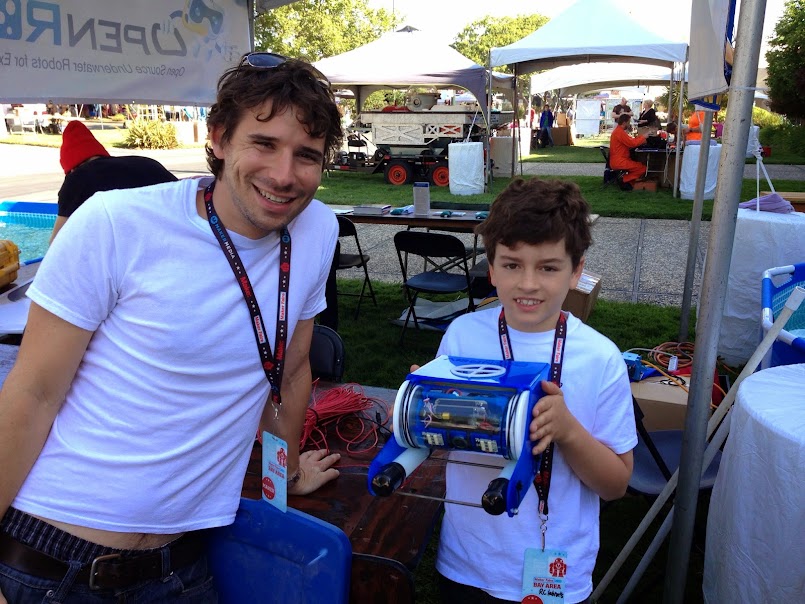
I'm on my way home from Maker Faire and I am still in awe that Beagles where everywhere! Clearly, BeagleBone Black is quickly becoming the embedded computer of choice for makers of all types. To start, BeagleBone is on the cover of Make Magazine and the huge banners of the magazine cover at the show. Within the enclosure of the OpenROV open hardware underwater remotely operated vehicle kit and ocean exploring project, you can just make out the outline of an included BeagleBone!
Above on the left is the cover of Make Magazine and on the right is Eric Stackpole sharing
with a young explorer at the show what the OpenROV community has made.
Back on land, one of the physically largest, or at least tallest, exhibits at the show is also driven by BeagleBone. Benjamin James of coolneon.com about his BeagleBone based LED wall. The wall consists of over 1,000 LEDs fed by an SPI serial port from BeagleBone. BeagleBone is also performing animations and he even has a massive scale Tetris implementation written by Christopher De Vries where kids share the controls and need to cooperate to succeed. He's also got a mode that uses another computer connected to a Kinect camera to feed information to the BeagleBone such that the LED wall can be "conducted" as if in a concert. Benjamin is a huge BeagleBone fan looking to bundle up his LEDs and BeagleBone-based controller so that anybody can make some incredible light displays.
Above on the left is a picture of the BeagleBone-based LED exhibit to the left of a full concert stage. On the right is an interview I did with the maker, Benjamin James.
Benjamin wasn't the only one showing off LED lighting solutions using BeagleBone and sharing source. Paul Stoffregen of DorkbotPDX out of Portland, Oregon has a BeagleBone Black based LED display solution fed by stomp pads connected to his affordable Teensy microcontroller modules, a webcam and his open source software. Openness and performance were huge factors for Paul as he tried using another popular low cost computer and found it was dropping frames. That non-Beagle computer simply didn't have the performance he needed and he found it dropping frames---all problems that went away using BeagleBone. Another factor for his choice is the consistent build quality he's found using boards from Circuitco and BeagleBoard.org. He did much of his development on his laptop computer and was able to move his code over to Beagle without any hassles in about half-a-day. He also notes that BeagleBone Black ships with the video-4-linux (V4L) drivers that enabled easy use of a webcam to drive his LED array. You can read more about his experience on his dorkbotpdx blog post about getting ready for this event.
Above is a quick interview I did with Paul Stoffregen about his BeagleBone Black based LED display.
I was able to grab a couple of other quick interviews with BeagleBone Black users at Maker Faire, including Marcus Schappi of Ninja Blocks and Edouard Lafargue who built a model train exhibit. Both of these users are running Ubuntu, perhaps the most popular desktop Linux distribution, on BeagleBone Black (as opposed to the Angstrom Distribution image shipped with the boards). Because BeagleBone Black runs armv7 instructions, it can run the latest Ubuntu builds for ARM. Both of these projects are focused on connecting sensors and controls to a web interface. There are great community write-ups on getting Ubuntu installed on BeagleBone Black.
On the left is an introduction to Ninja Blocks. In the middle is a quick interview I did with Marcus Schappi of Ninja Blocks at Maker Faire. On the right, Edouard Lafargue shows off his BeagleBone Black based web controlled train.
In addition to the ability to run Ubuntu, Edouard chose to use BeagleBone Black thanks to the project's true open nature including an open hardware design where he can get all of the design materials and documentation, and not need to use any closed binary blobs to boot his hardware. Porting his application from his Mac to his BeagleBone Black was simply taking only about half a day.
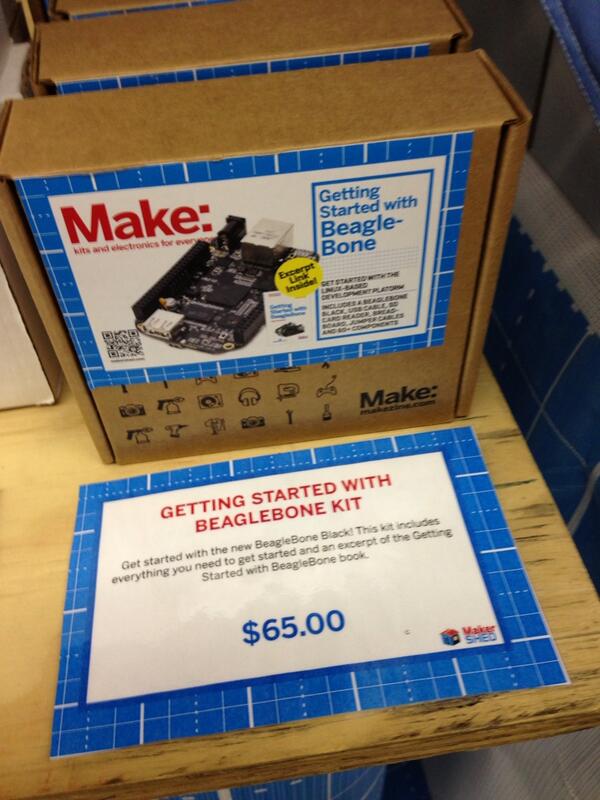
I spent much of my time at Maker Faire running around with my BeagleStache moustache camera running OpenCV. Below is a quick stache tweet I captured of Brian Jepson in the Maker Shed. While I was there, I also checked out the stock of BeagleBone Black. They didn't put out the BeagleBone Black boards until Sunday, but that didn't keep them from selling out before I managed to get back again. They also had a kit I haven't seen on-line yet that was $65 and included a pre-release preview of Matt Richardson's book "Getting Started with BeagleBone: Linux-Powered Electronic Projects With Python and JavaScript" and several other goodies including multiple breadboards and LEDs. The kits sold out as well.
I had many great discussions with other people showing me their BeagleBoard.org related projects including stuff they had now and stuff they were creating. A tremendous thanks to Hunyue Yau for doing so much to educate people about BeagleBoard.org with his BeagleBone-based ProtoBone Android tablet prototype. Hunyue focused his booth on BeagleBoard.org activities and answered question after question after question about BeagleBoard.org and BeagleBone. He was also kind enough to share his space with a couple of volunteers from Ansync Automation, Sam Miller and Tom, who partnered up with Uncanny Vision to demonstrate a BeagleBone-based robot using Ansync's motor controllers and Uncanny Vision's UncannyCV. They created a really cool and powerful color tracking robot that gave dozens of aspiring young makers joy in following them around on the expo floor and making its R2-D2 sound effects.
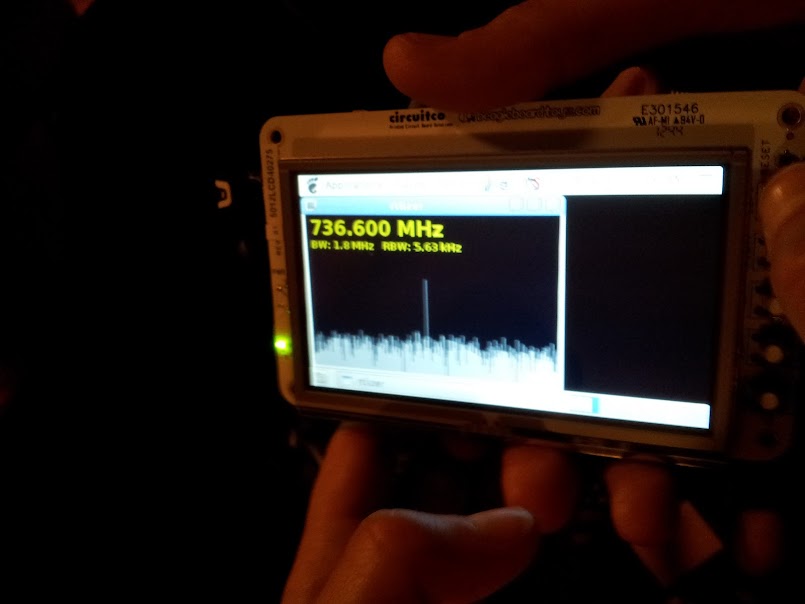
Another huge thanks goes to Drew Fustini, who frequently played host to Jessica and I, introducing us to many of the great makers that he knows and bringing the whole Texas Instruments crew out to Jeri Ellsworth's Bring-a-hack event. Drew brought a hack he got from the BeagleBoard.org community: an RF spectrum analyzer running on BeagleBone Black with a USB connected $25 receiver.
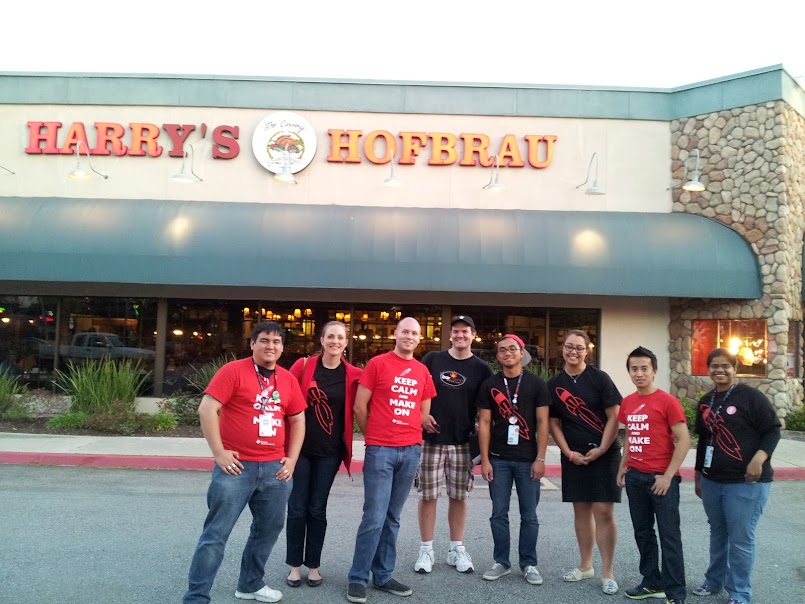
Above on the left is Drew Fustini. In the middle is a picture he took of the TIers going to Jeri's Bring-a-hack event. On the right is the RF spectrum analyzer Drew demonstrated at the event.
The whole experience was once in a lifetime and I never want to miss another Maker Faire. If you've ever thought about making something, anything, I really, really encourage you to register your idea on beagleboard.org/project, tell people about it on Google+ and the BeagleBoard.org Google Group getting their collaboration as needed, then propose it to one or more of the upcoming US Maker Faires or even the inaugural Maker Faire Europe in Rome still accepting applications until June 2nd. Happy Beagling!
It has been a big week for BeagleBoard.org. The next generation BeagleBone has been teased with a page open for registering interest. Matt Richardson created a teaser video and I showed off the board at ELC connected to an Motorola Lapdock to act as a monitor, keyboard, mouse and power supply. Victor Meyerson was also letting people know about the next-generation BeagleBone and provided BeagleWall, Motorola Lapdock and other demonstrations at SCaLE 11x where he was selected as the "Most passionate .org booth!"
Here's Matt's video about the upcoming BeagleBone:
Here are some pictures that Victor took at SCaLE showing the BeagleBoard.org booth with BeagleWall and Motorola Lapdock demos. The second picture shows a USB touchscreen connected to a BeagleBone using upstream kernel drivers for both the display (displaylink) and touch (e2i) portions as well as Xorg drivers provided by xf86-video-fbdev. Thanks again Victor (calculus on #beagle)!
Now is a great time for BeagleBoard.org and a great time to get involved. I am looking for more contributors to:
support in any of Linux distribution or other operating systems.
Join us at http://beagleboard.org/discuss and get involved today! I'll be posting requests for contributions to our Google Summer of Code ideas page soon.
Update: I corrected the blog post to say "most passionate" not "favorite" and added the link provided by Russ Dill.
Matt Ranostay opened up the presentations with "Beaglebone: The Perfect Telemetry Platform?" where he explored various telemetry applications such as weather stations, radiation monitors, earthquake detection mesh networks, home security systems and entropy pool generation. He discussed sharing data with tools like COSM and the hardware and software he developed for his own Geiger Cape plug-in board.
Matt Porter of Texas Instruments stepped away from sensors and controls bringing back the Commodore 64 demoscene with "What's Old Is New: A 6502-based Remote Processor". While this might seem like a bit of a throw-back, many modern issues and solutions were explored to give us this taste of the past, including the Linux remoteproc/virtio interfaces to remote processors, the AM335x PRUSS processor that is extremely adept at bit-banging and the Fritzing design tool. Matt has also shared a picture of his wiring handy-work.
Finally, Koen Kooi of CircuitCo presented on one of the fundamental BeagleBone challenges, "Supporting 200 Different Expansionboards: The Broken Promise of Devicetree". If you frequent #beagle, you probably already know that Koen isn't easy to please and so the title shouldn't be much of a surprise. You might then be surprised to note on the first slide where "broken" has been scratched out! We certainly aren't there yet, but the device tree maintainers and AM335x kernel developers are starting to address the unique opportunities around BeagleBone cape expansion boards in the mainline Linux kernel, making a reality out of the dream of supporting hundreds of boards with a single kernel distributed ahead of the add-ons!
The continued enthusiasm of the embedded Linux community is just one element of what makes BeagleBoard.org successful, but it probably makes me happier than any other. With many of these developers moving the state of the Linux kernel ahead and even looking at sharing their hardware ideas in the BeagleBone Cape Plug-in Board Design Contest, I see a bright future where the largest collaborative software project of all time fully embraces the hardware and maker communities such that we can build a world where individuals and even children can reproduce electronics and computers down to the circuit level, not simply build on black magic.
What is up with Google? We have hundreds of messages waiting moderation on the BeagleBoard Google Group, but the tool no longer enables message moderation---and absolutely no communications from Google. Have they simply bitten off more than they can chew? Are they trying to take too much control? Either way, I'm shopping for a new mailing list solution for BeagleBoard.org and, sorry, 99% of your suggestions aren't useful. We need low-setup costs, low/free hosting, long-term archival, excellent search tools and results in various engines, quality spam controls, easy-to-use moderation tools, forum-like thread organization and "top-pinning", digest and individual e-mails with threading and many more features for which Google Groups has barely been passable at this point.
Any thoughts on why this has happened and if Google will be a valid partner in the future?
This week, I went on the Amp Hour with Chris, Dave and Jeff. We spoke about a lot of things BeagleBoard related, including the upcoming next revision of the BeagleBoard.
Also, I wanted to remind everyone that there will be new hands-on training at ESC Boston this month and full-conference attendees will get a free BeagleBoard-xM, TinCanTools Beacon Board and TI MSP430 Chronos watch.
Lastly, I'm still on the look-out for a new primary host for the BeagleCast podcast. I will be recording another episode next week with Khasim Syed Mohammed regarding the Android Rowboat project (hopefully), but I'm looking for someone who can volunteer to organize and record/publish the shows on a regular basis. The audio recording must be of higher quality than we've done in the past.