
Tuesday, July 30, 2013
New home for BeagleBoard.org blog
I've moved this blog to http://beagleboard.org/blog. It just seems like an easier place to find it. I'm also going to try to start being more consistent with at-least-weekly posts.

Monday, July 29, 2013
BeagleBoard.org celebrates 5 years of enabling Linux DIY hacks

BeagleBoard.org launched with support of Digi-Key in 2008 and DIYers quickly adopted BeagleBoard for migrating XBMC to ARM, building GPS accurate down to the centimeter, eight-legged robots and creating controller hacks. In 2010, Google Summer of Code students contributed numerous projects to help other open source developers, including sniffing USB traffic and XBMC performance optimizations. GSoC students are back at it again in 2013, providing solutions for booting BeagleBone from aNexus phone, running Arduino sketches and even building new peripherals out of an on-chip microcontroller.
With the introduction of BeagleBoard-xM in 2010, projects accelerated with homemade tablet computers, open graphing calculators, cluster computing in abriefcase,repurposed laptop LCDs, remote presence and versatile RC robots, space cameras, USB killswitches and wearable LED matrices. BeagleBoard-based wearables back in 2010 even provided a strikingly similarity to today's Google Glass.
BeagleBone launched in 2011 to the cheers of robot makers everywhere, even robot makers looking to replace guide dogs and soothe the everyday angry bird, butinventiveness wasn't limited to awesome, futuristic robots. The tiny, low-power processing solution enabled tidy home power usage monitors, off-the-grid wireless outposts,QR code controlled door locks, networked LED marquees, portable 3D cameras and even cameras that would print scene descriptions in words. BeagleBone's portable performance was utilized for countless goals, including cracking passwords, manufacturing money and helping to save the world from pollution.
BeagleBone seemed to find a surprising home in retro computing, mimicking PDP11 blinkenlights and saving dot-matrix printers from the dust bin. This seemed to be an inspiration for inventive minds seeking to teach others about the more subtle capabilities the board is packing. The two, small 200MHz 32-bit microcontrollers on-board were used to mimic external peripherals to a discrete 6502 processor, enabling more people to understand the capabilities of these independent units previously demonstrated performing independent generation of VGA signals using a simple resistor ladder.
The tutorials continued with everything from twiddling an LED and running Ubuntu with a full GUI, to extracting video signals and wiring up your own LIDD displays, evenbuilding your own dedicated Pandora radio. This is all before BeagleBone Black launched, boosting performance to 1GHz, adding on-board eMMC and HDMI and dropping the price down to $45.
BeagleBone Black is just getting its legs underneath it in its initial production run of 125,000 units with around half of those shipped so far. Early adopters were able to share some of their creations at Maker Faire, including LED strips being used to display live video. Beyond the obvious and popular lighting solutions, BeagleBone Black has found an early home in manufacturing solutions, especially with makers like Elias Bakken, who created the contest-winning Replicape 3D printer-enabling add-on board and a tiny HDMI display for use with BeagleBone Black, and Charles Steinkuehler, who has created the MachineKit software image containing LinuxCNC and Xenomi real-time Linux kernel. Both Elias and Charles have been steady contributors to the project of late and have helped enable several of the improvements making BeagleBone Black a complete and easy to use solution for all sorts of makers.
BeagleBone Black is just getting its legs underneath it in its initial production run of 125,000 units with around half of those shipped so far. Early adopters were able to share some of their creations at Maker Faire, including LED strips being used to display live video. Beyond the obvious and popular lighting solutions, BeagleBone Black has found an early home in manufacturing solutions, especially with makers like Elias Bakken, who created the contest-winning Replicape 3D printer-enabling add-on board and a tiny HDMI display for use with BeagleBone Black, and Charles Steinkuehler, who has created the MachineKit software image containing LinuxCNC and Xenomi real-time Linux kernel. Both Elias and Charles have been steady contributors to the project of late and have helped enable several of the improvements making BeagleBone Black a complete and easy to use solution for all sorts of makers.
As of the recent June 20th software release for BeagleBone Black, significant improvements have been made since launch. Monitor support is greatly improved with better automated resolution setting and a documented process for setting specific resolutions over the command-line or at boot-up, including resolutions up to 1920x1080 at 24fps. The node.js-based BoneScript library, used in such fun things as multi-room physically interactive video games, has several bug fixes and a growing body of interactive wiring examples that work within Chrome and Firefox browsers. Support for the on-board 32-bit microcontrollers called PRUs has been improved with an updated assembler and documentation supporting previously undocumented instructions, including multipliers, and hints have been made at a C compiler being developed, including Pantelis Antoniou's example of using the PRU C compiler to add 32 additional channels of pulse-width modulation (PWM). The value of aggressively chasing the mainline kernel is also being shown with simple command-line statements for enabling UARTs, SPI, I2C, CAN and more peripherals, including improved cape add-on board support.
With an amazing community, stand-out performance and capability, a true open hardware approach that is sustainably profitable but not greedy, continuous demonstrated improvements and a focus on educating aspiring engineers and hobbyists alike, BeagleBoard.org has proven to be a DIY force with which to reckon and an inspiration for makers everywhere. Happy Birthday Boris!
Tuesday, July 16, 2013
BeagleBoard.org GSoC 2013 update
In the last blog post, the students and mentors were introduced and links were given to the projects. The Minix I2C project shared a video for the last post and has progressed as far as pushing initial I2C support into the Minix mainline. A couple of the other students have now provided some videos describing their projects.
First, the Beagle-ROS project...
...and now a bit on the project to add IIO support to the Linux mainline for the BeagleBone Black ADC...
The Userspace Arduino project has also made some excellent progress, demonstrating running Arduino sketches on BeagleBone Black...
The BeagleBoard Android Boot project has also produced successful bootloading from a Nexus phone.
First, the Beagle-ROS project...
...and now a bit on the project to add IIO support to the Linux mainline for the BeagleBone Black ADC...
The Userspace Arduino project has also made some excellent progress, demonstrating running Arduino sketches on BeagleBone Black...
The BeagleBoard Android Boot project has also produced successful bootloading from a Nexus phone.
Friday, June 14, 2013
BeagleBoard.org Google Summer of Code 2013 -- coding starts this Monday, June 17
BeagleBoard.org is just about to kick-off coding on our second time as a mentoring organization for Google Summer of Code. This is an amazing program that pays students for writing open source software over Summer. Seven (7) students will be participating in projects that advance the state of open source software for Beagle users and will earn them each US$5,000 if they are successful. Twenty-three (23) qualified mentors from the BeagleBoard.org community have volunteered to help the students reach their goals.
Each project has a page on BeagleBoard.org giving a bit of a description of the project linked in the table below. Each of those pages in turn links to blogs where the students will update the BeagleBoard.org community on their progress. Most of the daily collaboration will be happening on the #beagle-gsoc IRC channel, including weekly status meetings, which are all being logged. The nicknames of each student and mentor are included in square brackets in the table below, so you can contact them with any feedback you might have. You might also choose to join the BeagleBoard-GSoC Google Group for related announcements and additional technical discussion on the projects.
Each of the projects is rather interesting and you'll be able to read more about them here in the weeks to come. Scroll past the table below for a video describing one of the projects, the development of I2C drivers for the Minix operating system.
| Project | Student | Mentors (* = primary) |
|---|---|---|
| Minix I2C drivers for the BeagleBone Black | Thomas Cort (Heritage College in Canada) [tcort] | Kees Jongenburger* [keesj], Ben Gras [beng-nl], Frans Meulenbroeks [effem] |
| Arduino for userspace Linux | Anuj Deshpande (Pune Institute of Computer Technology in India) [hatguy_] and Parav Nagarsheth (Nirma University in India) [anujdeshpande] | David Anders* [prpplague], Matt Porter [mdp], Andrew Bradford [bradfa], Luis Gustavo Lira [lglira] |
| Android-based boot system | Vlad Victor Ungureanu (Jacobs University Bremen in Germany) [vvu] | Vladimir Pantelic* [av500], Tom King [ka6sox], Kees Jongenburger [keesj] |
| Software Defined Peripherals: JTAG/Debug via PRU | Jon Bailey (University of Waterloo in Canada) [jj2baile] | Tom King* [ka6sox], Andrew Bradford [bradfa], Pantelis Antoniou [panto], Hunyue Yau [ds2], Matt Ranostay [mranostay] |
| IIO, ADC, PMIC, LCD debug/patchwork | Zubair Lutfullah Kakakhel (University of Leeds in UK) [ZubairLK] | Greg Kroah-Hartman* [gregkh], Koen Kooi [koen], Vladimir Pantelic [av500], Tom Rini [Tartarus], Laine Walker-Avina [Ceriand] |
| Beagle-ROS | Víctor Mayoral Vilches (Universidad Rey Juan Carlos in Spain) [vmayoral] | Koen Kooi* [koen], Khem Raj [khem] |
One of the students has already posted a video describing their project and all of the students will eventually provide video presentations of their projects, so stay tuned if you want to be video-spoon-fed.
Thanks to Thomas for providing that video. Of course, there are several other individuals involved in supporting this year's Summer of Code, including, but certainly not limited to:
Our mentors-at-large: Derek Molloy (general BeagleBone) [molloyd], Mans Rullgard (ARM) [mru], Karim Yaghmour (Android), Russ Dill [Russ], Jason Kridner (BeagleBoard.org GSoC administrator) [jkridner] and
Our backup administrator (and all around amazing person): Cathy Wicks [cwicks].
Thanks to everyone for their participation and support. Looking forward to an amazing Summer!
--Jason
Tuesday, May 21, 2013
BeagleBone Black was a huge hit at Maker Faire!
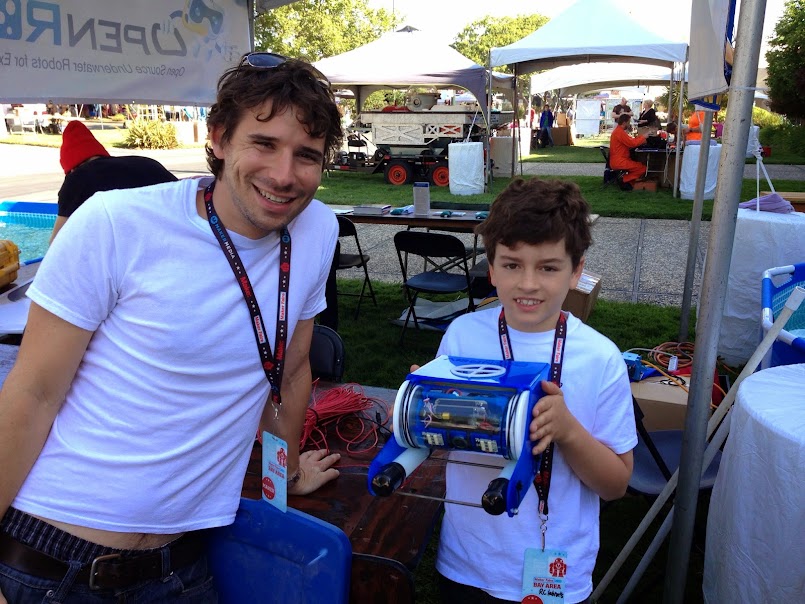
I'm on my way home from Maker Faire and I am still in awe that Beagles where everywhere! Clearly, BeagleBone Black is quickly becoming the embedded computer of choice for makers of all types. To start, BeagleBone is on the cover of Make Magazine and the huge banners of the magazine cover at the show. Within the enclosure of the OpenROV open hardware underwater remotely operated vehicle kit and ocean exploring project, you can just make out the outline of an included BeagleBone!

Back on land, one of the physically largest, or at least tallest, exhibits at the show is also driven by BeagleBone. Benjamin James of coolneon.com about his BeagleBone based LED wall. The wall consists of over 1,000 LEDs fed by an SPI serial port from BeagleBone. BeagleBone is also performing animations and he even has a massive scale Tetris implementation written by Christopher De Vries where kids share the controls and need to cooperate to succeed. He's also got a mode that uses another computer connected to a Kinect camera to feed information to the BeagleBone such that the LED wall can be "conducted" as if in a concert. Benjamin is a huge BeagleBone fan looking to bundle up his LEDs and BeagleBone-based controller so that anybody can make some incredible light displays.

Benjamin wasn't the only one showing off LED lighting solutions using BeagleBone and sharing source. Paul Stoffregen of DorkbotPDX out of Portland, Oregon has a BeagleBone Black based LED display solution fed by stomp pads connected to his affordable Teensy microcontroller modules, a webcam and his open source software. Openness and performance were huge factors for Paul as he tried using another popular low cost computer and found it was dropping frames. That non-Beagle computer simply didn't have the performance he needed and he found it dropping frames---all problems that went away using BeagleBone. Another factor for his choice is the consistent build quality he's found using boards from Circuitco and BeagleBoard.org. He did much of his development on his laptop computer and was able to move his code over to Beagle without any hassles in about half-a-day. He also notes that BeagleBone Black ships with the video-4-linux (V4L) drivers that enabled easy use of a webcam to drive his LED array. You can read more about his experience on his dorkbotpdx blog post about getting ready for this event.
I was able to grab a couple of other quick interviews with BeagleBone Black users at Maker Faire, including Marcus Schappi of Ninja Blocks and Edouard Lafargue who built a model train exhibit. Both of these users are running Ubuntu, perhaps the most popular desktop Linux distribution, on BeagleBone Black (as opposed to the Angstrom Distribution image shipped with the boards). Because BeagleBone Black runs armv7 instructions, it can run the latest Ubuntu builds for ARM. Both of these projects are focused on connecting sensors and controls to a web interface. There are great community write-ups on getting Ubuntu installed on BeagleBone Black.
In addition to the ability to run Ubuntu, Edouard chose to use BeagleBone Black thanks to the project's true open nature including an open hardware design where he can get all of the design materials and documentation, and not need to use any closed binary blobs to boot his hardware. Porting his application from his Mac to his BeagleBone Black was simply taking only about half a day.
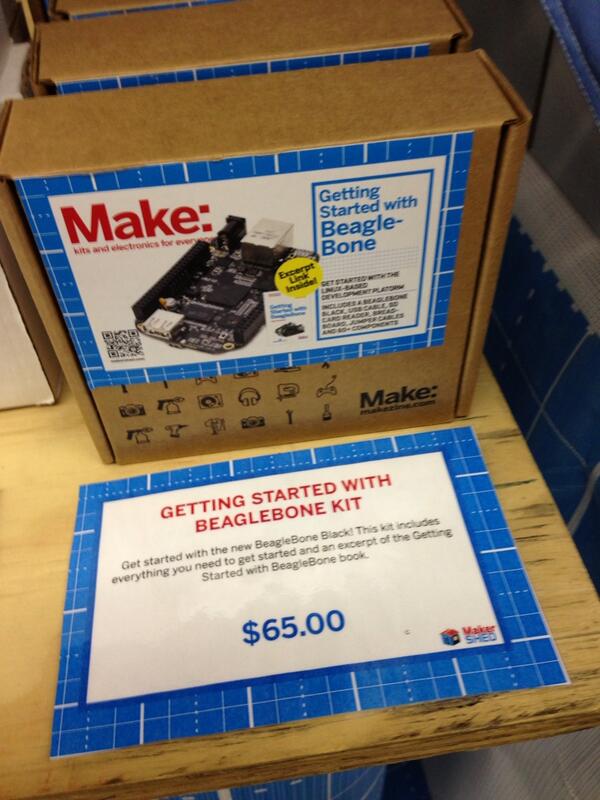 I spent much of my time at Maker Faire running around with my BeagleStache moustache camera running OpenCV. Below is a quick stache tweet I captured of Brian Jepson in the Maker Shed. While I was there, I also checked out the stock of BeagleBone Black. They didn't put out the BeagleBone Black boards until Sunday, but that didn't keep them from selling out before I managed to get back again. They also had a kit I haven't seen on-line yet that was $65 and included a pre-release preview of Matt Richardson's book "Getting Started with BeagleBone: Linux-Powered Electronic Projects With Python and JavaScript" and several other goodies including multiple breadboards and LEDs. The kits sold out as well.
I had many great discussions with other people showing me their BeagleBoard.org related projects including stuff they had now and stuff they were creating. A tremendous thanks to Hunyue Yau for doing so much to educate people about BeagleBoard.org with his BeagleBone-based ProtoBone Android tablet prototype. Hunyue focused his booth on BeagleBoard.org activities and answered question after question after question about BeagleBoard.org and BeagleBone. He was also kind enough to share his space with a couple of volunteers from Ansync Automation, Sam Miller and Tom, who partnered up with Uncanny Vision to demonstrate a BeagleBone-based robot using Ansync's motor controllers and Uncanny Vision's UncannyCV. They created a really cool and powerful color tracking robot that gave dozens of aspiring young makers joy in following them around on the expo floor and making its R2-D2 sound effects.

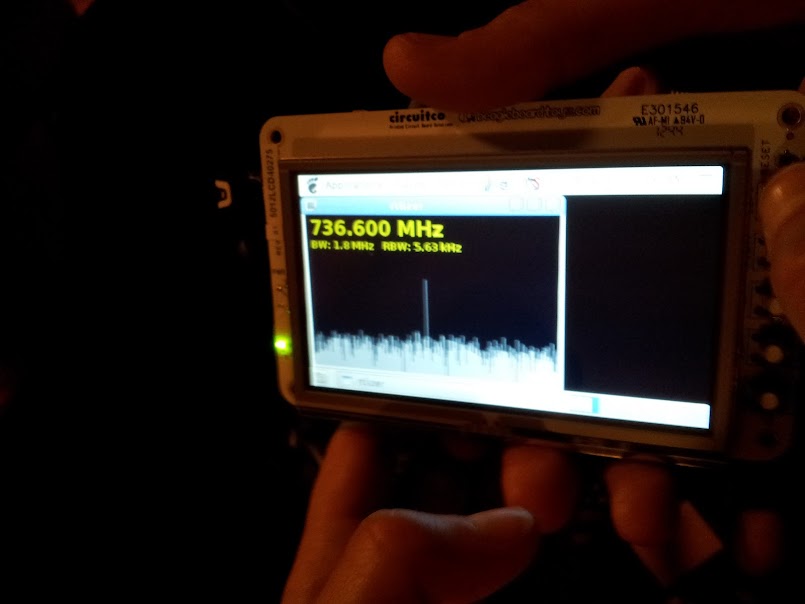
Another huge thanks goes to Drew Fustini, who frequently played host to Jessica and I, introducing us to many of the great makers that he knows and bringing the whole Texas Instruments crew out to Jeri Ellsworth's Bring-a-hack event. Drew brought a hack he got from the BeagleBoard.org community: an RF spectrum analyzer running on BeagleBone Black with a USB connected $25 receiver.

The whole experience was once in a lifetime and I never want to miss another Maker Faire. If you've ever thought about making something, anything, I really, really encourage you to register your idea on beagleboard.org/project, tell people about it on Google+ and the BeagleBoard.org Google Group getting their collaboration as needed, then propose it to one or more of the upcoming US Maker Faires or even the inaugural Maker Faire Europe in Rome still accepting applications until June 2nd. Happy Beagling!
Above on the left is the cover of Make Magazine and on the right is Eric Stackpole sharing
with a young explorer at the show what the OpenROV community has made.
Back on land, one of the physically largest, or at least tallest, exhibits at the show is also driven by BeagleBone. Benjamin James of coolneon.com about his BeagleBone based LED wall. The wall consists of over 1,000 LEDs fed by an SPI serial port from BeagleBone. BeagleBone is also performing animations and he even has a massive scale Tetris implementation written by Christopher De Vries where kids share the controls and need to cooperate to succeed. He's also got a mode that uses another computer connected to a Kinect camera to feed information to the BeagleBone such that the LED wall can be "conducted" as if in a concert. Benjamin is a huge BeagleBone fan looking to bundle up his LEDs and BeagleBone-based controller so that anybody can make some incredible light displays.

Above on the left is a picture of the BeagleBone-based LED exhibit to the left of a full concert stage. On the right is an interview I did with the maker, Benjamin James.
Benjamin wasn't the only one showing off LED lighting solutions using BeagleBone and sharing source. Paul Stoffregen of DorkbotPDX out of Portland, Oregon has a BeagleBone Black based LED display solution fed by stomp pads connected to his affordable Teensy microcontroller modules, a webcam and his open source software. Openness and performance were huge factors for Paul as he tried using another popular low cost computer and found it was dropping frames. That non-Beagle computer simply didn't have the performance he needed and he found it dropping frames---all problems that went away using BeagleBone. Another factor for his choice is the consistent build quality he's found using boards from Circuitco and BeagleBoard.org. He did much of his development on his laptop computer and was able to move his code over to Beagle without any hassles in about half-a-day. He also notes that BeagleBone Black ships with the video-4-linux (V4L) drivers that enabled easy use of a webcam to drive his LED array. You can read more about his experience on his dorkbotpdx blog post about getting ready for this event.
Above is a quick interview I did with Paul Stoffregen about his BeagleBone Black based LED display.
I was able to grab a couple of other quick interviews with BeagleBone Black users at Maker Faire, including Marcus Schappi of Ninja Blocks and Edouard Lafargue who built a model train exhibit. Both of these users are running Ubuntu, perhaps the most popular desktop Linux distribution, on BeagleBone Black (as opposed to the Angstrom Distribution image shipped with the boards). Because BeagleBone Black runs armv7 instructions, it can run the latest Ubuntu builds for ARM. Both of these projects are focused on connecting sensors and controls to a web interface. There are great community write-ups on getting Ubuntu installed on BeagleBone Black.
On the left is an introduction to Ninja Blocks. In the middle is a quick interview I did with Marcus Schappi of Ninja Blocks at Maker Faire. On the right, Edouard Lafargue shows off his BeagleBone Black based web controlled train.
I spent much of my time at Maker Faire running around with my BeagleStache moustache camera running OpenCV. Below is a quick stache tweet I captured of Brian Jepson in the Maker Shed. While I was there, I also checked out the stock of BeagleBone Black. They didn't put out the BeagleBone Black boards until Sunday, but that didn't keep them from selling out before I managed to get back again. They also had a kit I haven't seen on-line yet that was $65 and included a pre-release preview of Matt Richardson's book "Getting Started with BeagleBone: Linux-Powered Electronic Projects With Python and JavaScript" and several other goodies including multiple breadboards and LEDs. The kits sold out as well.At #makerfaire? Give @jadon your card for the chance to win @beagleboardorg #beagleboneblack or #badtothebone! twitter.com/BeagleStache/s…
— Boris Houndleroy (@BeagleStache) May 18, 2013
I had many great discussions with other people showing me their BeagleBoard.org related projects including stuff they had now and stuff they were creating. A tremendous thanks to Hunyue Yau for doing so much to educate people about BeagleBoard.org with his BeagleBone-based ProtoBone Android tablet prototype. Hunyue focused his booth on BeagleBoard.org activities and answered question after question after question about BeagleBoard.org and BeagleBone. He was also kind enough to share his space with a couple of volunteers from Ansync Automation, Sam Miller and Tom, who partnered up with Uncanny Vision to demonstrate a BeagleBone-based robot using Ansync's motor controllers and Uncanny Vision's UncannyCV. They created a really cool and powerful color tracking robot that gave dozens of aspiring young makers joy in following them around on the expo floor and making its R2-D2 sound effects.
Above on the left is Hunyue Yau's ProtoBone BeagleBone-based Android tablet prototype. On the right is a video of Tom describing the Ansync BeagleBot.
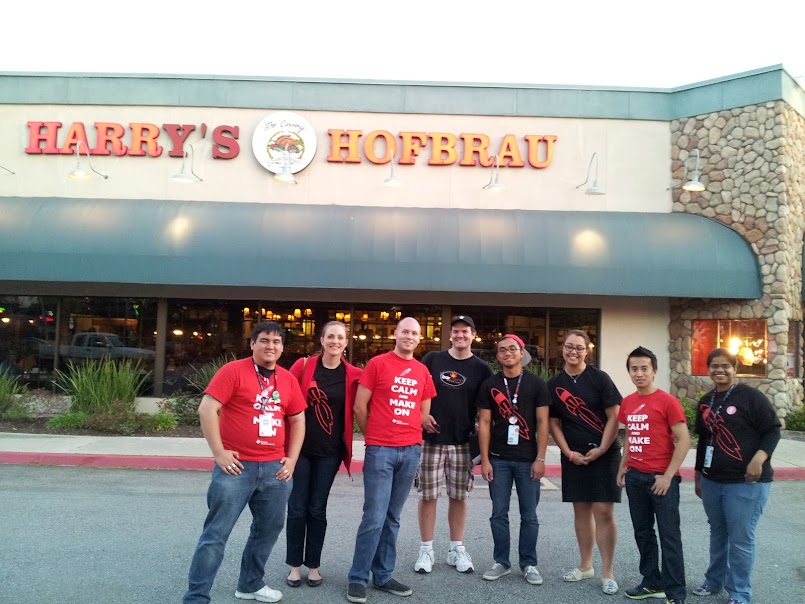
Another huge thanks goes to Drew Fustini, who frequently played host to Jessica and I, introducing us to many of the great makers that he knows and bringing the whole Texas Instruments crew out to Jeri Ellsworth's Bring-a-hack event. Drew brought a hack he got from the BeagleBoard.org community: an RF spectrum analyzer running on BeagleBone Black with a USB connected $25 receiver.

Above on the left is Drew Fustini. In the middle is a picture he took of the TIers going to Jeri's Bring-a-hack event. On the right is the RF spectrum analyzer Drew demonstrated at the event.
The whole experience was once in a lifetime and I never want to miss another Maker Faire. If you've ever thought about making something, anything, I really, really encourage you to register your idea on beagleboard.org/project, tell people about it on Google+ and the BeagleBoard.org Google Group getting their collaboration as needed, then propose it to one or more of the upcoming US Maker Faires or even the inaugural Maker Faire Europe in Rome still accepting applications until June 2nd. Happy Beagling!
Monday, February 25, 2013
BeagleBoard.org at ELC and SCaLE
It has been a big week for BeagleBoard.org. The next generation BeagleBone has been teased with a page open for registering interest. Matt Richardson created a teaser video and I showed off the board at ELC connected to an Motorola Lapdock to act as a monitor, keyboard, mouse and power supply. Victor Meyerson was also letting people know about the next-generation BeagleBone and provided BeagleWall, Motorola Lapdock and other demonstrations at SCaLE 11x where he was selected as the "Most passionate .org booth!"
Here's Matt's video about the upcoming BeagleBone:
Here are some pictures that Victor took at SCaLE showing the BeagleBoard.org booth with BeagleWall and Motorola Lapdock demos. The second picture shows a USB touchscreen connected to a BeagleBone using upstream kernel drivers for both the display (displaylink) and touch (e2i) portions as well as Xorg drivers provided by xf86-video-fbdev. Thanks again Victor (calculus on #beagle)!


Now is a great time for BeagleBoard.org and a great time to get involved. I am looking for more contributors to:
- the mainline kernel effort with patches being staged at http://github.com/beagleboard/kernel,
- support for the mainline kernel for doing physical computing in JavaScript at http://github.com/jadonk/bonescript,
- improvements to the distro used to make the boards useful out-of-the-box at http://www.angstrom-distribution.org/building-angstrom and
- support in any of Linux distribution or other operating systems.
Join us at http://beagleboard.org/discuss and get involved today! I'll be posting requests for contributions to our Google Summer of Code ideas page soon.
Update: I corrected the blog post to say "most passionate" not "favorite" and added the link provided by Russ Dill.
Update: I corrected the blog post to say "most passionate" not "favorite" and added the link provided by Russ Dill.
Tuesday, November 13, 2012
BeagleBone and Linux seeking cure to hardware black magic
Embedded Linux Conference Europe (ELC-E) 2012 wrapped up last week in Barcelona. By far, the most popular embedded platform of choice for demonstrations was BeagleBone. Here are four examples that include links to the slides taken from the eLinux wiki ELC-E presentation page. Videos of the presentations should be available from Free Electrons soon.


The continued enthusiasm of the embedded Linux community is just one element of what makes BeagleBoard.org successful, but it probably makes me happier than any other. With many of these developers moving the state of the Linux kernel ahead and even looking at sharing their hardware ideas in the BeagleBone Cape Plug-in Board Design Contest, I see a bright future where the largest collaborative software project of all time fully embraces the hardware and maker communities such that we can build a world where individuals and even children can reproduce electronics and computers down to the circuit level, not simply build on black magic.
Saturday, March 31, 2012
Problems with Google (Groups)
What is up with Google? We have hundreds of messages waiting moderation on the BeagleBoard Google Group, but the tool no longer enables message moderation---and absolutely no communications from Google. Have they simply bitten off more than they can chew? Are they trying to take too much control? Either way, I'm shopping for a new mailing list solution for BeagleBoard.org and, sorry, 99% of your suggestions aren't useful. We need low-setup costs, low/free hosting, long-term archival, excellent search tools and results in various engines, quality spam controls, easy-to-use moderation tools, forum-like thread organization and "top-pinning", digest and individual e-mails with threading and many more features for which Google Groups has barely been passable at this point.
Any thoughts on why this has happened and if Google will be a valid partner in the future?
Any thoughts on why this has happened and if Google will be a valid partner in the future?
Tuesday, September 6, 2011
BeagleBoard on The Amp Hour and at ESC Boston
This week, I went on the Amp Hour with Chris, Dave and Jeff. We spoke about a lot of things BeagleBoard related, including the upcoming next revision of the BeagleBoard.
Also, I wanted to remind everyone that there will be new hands-on training at ESC Boston this month and full-conference attendees will get a free BeagleBoard-xM, TinCanTools Beacon Board and TI MSP430 Chronos watch.
Lastly, I'm still on the look-out for a new primary host for the BeagleCast podcast. I will be recording another episode next week with Khasim Syed Mohammed regarding the Android Rowboat project (hopefully), but I'm looking for someone who can volunteer to organize and record/publish the shows on a regular basis. The audio recording must be of higher quality than we've done in the past.
Also, I wanted to remind everyone that there will be new hands-on training at ESC Boston this month and full-conference attendees will get a free BeagleBoard-xM, TinCanTools Beacon Board and TI MSP430 Chronos watch.
Lastly, I'm still on the look-out for a new primary host for the BeagleCast podcast. I will be recording another episode next week with Khasim Syed Mohammed regarding the Android Rowboat project (hopefully), but I'm looking for someone who can volunteer to organize and record/publish the shows on a regular basis. The audio recording must be of higher quality than we've done in the past.
Friday, July 29, 2011
BeagleBoard turns 3.0!

Linux is turning 20 years old this year and Linus has released version 3.0. You can try 3.0 out on the BeagleBoard or BeagleBoard-xM prior to rev C and it should work for you pretty well. Support for xM rev C was merged after the 3.0 release for inclusion in 3.1. If you'd like to pull a patch set that gives you power management, 1GHz support and some other features not yet placed into the mainline yet, you can check out the patch set in the meta-texasinstruments OE repository. Koen also has also released a set of pre-build binaries and modules using these kernel patches if you want to try out a fairly full-featured 3.0 kernel build for the BeagleBoard/BeagleBoard-xM.
I haven't tried it out yet, but the Linaro 11.06 Android evaluation build also includes a 3.0 kernel for your BeagleBoard-xM.
Happy Beagle 3.0!!!!
Tuesday, May 10, 2011
BeagleCast 2011-05-06: Talking ARM with Greg K-H
Today we interview Greg Kroah-Hartman and your hosts are Jason Kridner and Jeffery Osier-Mixon. Gerald will be back in two weeks.
To provide questions or suggestions:
- Call +1-713-234-0535 or
- visit the BeagleCast suggestions form
Links to show topics
- Some in stock @ Digi-Key this week!
- A 300ms BeagleBoard boot?
- Using git submodule and busybox to track mainline development
- Announcing the Level One eXpansion (LOX) Board
- BeagleBoard at Embedded Linux Conference (CATCAN, Gumstix Stagecoach, SuperJumbo, Avnet, and WLAN hacking)
- Always Innovating talk at the 2011 Embedded Linux Conference
- Sandia cluster of 49 OMAP3s
- TI introduces OpenLink
- Processing and Processing-JS on the BeagleBoard under Angstrom
- BeagleBoard based oscilloscope using JavaScript and Processing.JS
- Arduino IDE and upload with avrdude to Trainerboard (AVRISP2)
- Processing on Beagleboard xM
- Making Processing/Arduino IDE/ReplicaorG work on ARM
- Android Oscilloscope on the Beagleboard xM using Rowboat
- Maker Faire Bay Area, May 21-22, 2011
- ESC Chicago, June 6-8, 2011
- Stompbox Design Summer Workshop at Stanford University, July 18-July 22, 2011
Wednesday, March 30, 2011
Indiana Linuxfest and the CATCAN quadpod
I was at Indiana Linuxfest this weekend. A couple of BeagleBoard-xMs were raffled off in support of the conference and it seemed a lot of people were interested. I gave a brief talk about the BeagleBoard project, Mark Yoder from Rose-Hulman and his students gave hands-on training to those interested in the Hackerspace Village and we had a BeagleBoard.org table for part of Saturday.
On Friday before I left for the show, I got a package from CATCAN in Taiwan containing two BeagleBoard-based robots and not much else; certainly nothing else I understood. I left the hexpod at home to make sure it wasn't damaged and took the quadpod with me. Sitting at the table, a group gathered and we figured out what we thought was the right way to connect the battery. The first thing we noticed was this ominous shrill after applying power. As we sat nervously wondering what was going to happen when we applied power, one person sitting at the Linux in the Ham Shack table noted a resemblance of the bot to the evil metal spiders in Dr. Who.
We decided that the shrill was likely the fans in the servo motors. You can block it out after a while, but it is loud and frightening. There was some concern that this meant that the servos were under strain, especially given that the motors were all moving themselves in addition to the legs, but I'm pretty sure we ruled that out and it really is the fans.
Knowing from the CATCAN and BeagleBoard.tw websites that this bot was running Android, a random group of us sitting around the table decided to hook up a serial port and tried to figure out what made the bot move. Being Android without any additional GNU utilities in the file system, the shell can be a bit frustrating. We couldn't hit backspace or perform tab completion. However, obvious commands, like 'ls', 'cd' and 'cat' are there so we could go about our exploring.
One of the first files we found was a log in /data/dontpanic. We found that quite reassuring. Eventually we found /system/etc/init.hexapod.sh and the fact that it pointed to executing /data/test-long-time-hexapod. Sure enough, running that executable sent our bot back through its motions. Running it from the shell gave us a printout of 13 different numerical values--the same number of motors on the bot. Eventually, I'll need to figure out how to recharge this bot--unless I have somehow underestimated its capabilities. I'm still a bit away from figuring out how to give it my own directions, but I think I have a start now--thanks to the attendees of Indiana Linuxfest!
It wasn't all games on the show floor, I also enjoyed a few of the talks. I especially enjoyed the presentation on Open Hardware by Joshua Burton. I am anxious to figure out what I can do with a Bug or BeagleBoard and the realtime sensor data aggregator Panchube. Joshua also introduced me to the work of Rodney Brooks who, among other interesting things, contributes to Edge.
I also picked up a bit I didn't realize in the Ubuntu for ARM presentation by David Mandella. One thing that surprised me is that the 10.04 release for ARM isn't considered "LTS" or long term supported. David predicts that the 12.04 is likely to be the first LTS release for ARM. With the Linaro work on the device tree and lots of OMAP/BeagleBoard patches being accepted into the mainline Linux kernel, I expect that to be a stellar release for the BeagleBoard users out there.
The presentations were recorded, so hopefully I'll be able to provide an update with the recorded presentations.
Update (3/30/2011): Sog Yang gave me this link to find a charger: http://www.rc-airplanes-simplified.com/rc-battery-chargers.html
On Friday before I left for the show, I got a package from CATCAN in Taiwan containing two BeagleBoard-based robots and not much else; certainly nothing else I understood. I left the hexpod at home to make sure it wasn't damaged and took the quadpod with me. Sitting at the table, a group gathered and we figured out what we thought was the right way to connect the battery. The first thing we noticed was this ominous shrill after applying power. As we sat nervously wondering what was going to happen when we applied power, one person sitting at the Linux in the Ham Shack table noted a resemblance of the bot to the evil metal spiders in Dr. Who.
We decided that the shrill was likely the fans in the servo motors. You can block it out after a while, but it is loud and frightening. There was some concern that this meant that the servos were under strain, especially given that the motors were all moving themselves in addition to the legs, but I'm pretty sure we ruled that out and it really is the fans.
Knowing from the CATCAN and BeagleBoard.tw websites that this bot was running Android, a random group of us sitting around the table decided to hook up a serial port and tried to figure out what made the bot move. Being Android without any additional GNU utilities in the file system, the shell can be a bit frustrating. We couldn't hit backspace or perform tab completion. However, obvious commands, like 'ls', 'cd' and 'cat' are there so we could go about our exploring.
One of the first files we found was a log in /data/dontpanic. We found that quite reassuring. Eventually we found /system/etc/init.hexapod.sh and the fact that it pointed to executing /data/test-long-time-hexapod. Sure enough, running that executable sent our bot back through its motions. Running it from the shell gave us a printout of 13 different numerical values--the same number of motors on the bot. Eventually, I'll need to figure out how to recharge this bot--unless I have somehow underestimated its capabilities. I'm still a bit away from figuring out how to give it my own directions, but I think I have a start now--thanks to the attendees of Indiana Linuxfest!
It wasn't all games on the show floor, I also enjoyed a few of the talks. I especially enjoyed the presentation on Open Hardware by Joshua Burton. I am anxious to figure out what I can do with a Bug or BeagleBoard and the realtime sensor data aggregator Panchube. Joshua also introduced me to the work of Rodney Brooks who, among other interesting things, contributes to Edge.
I also picked up a bit I didn't realize in the Ubuntu for ARM presentation by David Mandella. One thing that surprised me is that the 10.04 release for ARM isn't considered "LTS" or long term supported. David predicts that the 12.04 is likely to be the first LTS release for ARM. With the Linaro work on the device tree and lots of OMAP/BeagleBoard patches being accepted into the mainline Linux kernel, I expect that to be a stellar release for the BeagleBoard users out there.
The presentations were recorded, so hopefully I'll be able to provide an update with the recorded presentations.
Update (3/30/2011): Sog Yang gave me this link to find a charger: http://www.rc-airplanes-simplified.com/rc-battery-chargers.html
Monday, March 28, 2011
BeagleCast 2011-03-25: Super Jumbo
The theme of today's show is "Super Jumbo" and your hosts are Jason Kridner, Gerald Coley and Jeffery Osier-Mixon.
To provide questions or suggestions:
- Call +1-713-234-0535 or
- visit the BeagleCast suggestions form
Headline news
- Windows Compact 7
- Two new Distributors in China -- ChipSee -- CATCAN
- FFmpeg fork becomes libav
- Clojure on The Beagleboard -- What is a closure vs. what is Clojure?
- The 2.6.38 kernel is out
- What Is CLFS? - File System - Check!
- OpenEmbedded at CeBIT 2011 -- Should we still be excited about CES and CeBIT?
- Face chasing BeagleBoard-based robot using a Kinect
- How to build QT Framework 4.7.2 and OpenCV 2.2 for Beagleboard-xM -- How to build sample program for capturing image from camera (OpenCV and Qt)
- SPI with Trainer-xM
- Running CyanogenMod on BeagleBoard -- What is CyanogenMod? -- What is Rowboat?
- NEWS IGEPv2 goes Open Hardware
- Open Hardware Summit date announced for 2011? -- Looking for votes on a logo
- Beagleboard: Power usage (current draw) for certain scenarios
Community activity
- GSoC Update -- BeagleBoard.org not a mentoring organization this year -- Still looking for mentors to volunteer to mentor in other projects -- Considering a smaller scale BeagleBoard Summer of Code
- Always Innovating Announcement...Super Jumbo Beagle Buffet!
- Khasim Syed Mohammed will be on next week to discuss the Android Rowboat project
Tuesday, March 15, 2011
BeagleCast 2011-03-14: BeagleBoard-xM rev C
Today's hosts are Jason Kridner, Gerald Coley and Jeffery Osier-Mixon. Below are the show note links.
Links to the recordings
To provide questions or suggestions:
- Call +1-713-234-0535 or
- visit the BeagleCast suggestions form
- Running a BeagleBoard off of Batteries
- BeagleBoard cases with a MakerBot on Thingiverse
- New SGX Graphics Driver Release 4.03.00.02 for Linux now available!
- DVI-D to VGA converter for BeagleBoard-xM and issue to be fixed with the current BeagleBoardToys VGA adapter when using a BeagleBoard-xM
- Kinect + BeagleBoard-xM (now need GLES)
- Leverett and Wasson Win Texas Instruments Beagle Board Design Challenge
- Toolchain, Check! Kernel, Check! - Cross Linux From Scratch
Upcoming events
- Tweet @Jadon for free BeagleBoard hands-on training on March 26th at Indiana Linuxfest going on March 25-27
- Linux Collaboration Summit on April 6-8
- Embedded Linux Conference on April 11-13
- Maker Faire Bay Area on May 21-22
- New release candidate from Angstrom
- FAT vs. ext2
- boot.scr vs uEnv.txt change is not welcomed by all
- Why won't old MLO and u-boot work with xM rev C?
- Mark Yoder's ECE497 class with some students using the Kinect
- Collecting Google Summer of Code project ideas such as the car PC project
The theme music for BeagleCast was created and provided by Alasdair Drake.
Tuesday, March 8, 2011
BeagleCast 2011-03-07: The inaugural podcast
Today's hosts are Jason Kridner, Gerald Coley and Jeffery Osier-Mixon. Below are the show note links.
Links to the recordings
To provide questions or suggestions:
- Call +1-713-234-0535 or
- visit the BeagleCast suggestions form
Jeff and Yocto
- Jeff at a conference near the Columbia river gorge
- Jeff now the Yocto community manager
- Yocto includes Poky build tools, is multiplatform and has a BeagleBoard BSP
- Yocto gets many new partners
- What does it mean to join with OpenEmbedded?
- OE and Gentoo share roots
- Arago Project
- Koen working on the oe-core
- eLinux wiki summary of embedded Linux projects
- Wikis "are like bread" (good when fresh)
- BeagleBoard.org and Google Summer of Code
- oe-core status update and Yocto birds of a feather at ELC week of April 10
SD card discussion
- Amazon selling consumer friendly packaging
- SD card performance shootout needed to measure controller performance
BeagleBoard and electronics hobbyists of all ages
News from the BeagleBoard.org RSS feed and elsewhere
- Cloud9 IDE on BeagleBoard
- BeagleBoard Trainer-xM
- Contributing upstream patches, such as uEnv.txt patch in u-boot
- The move from ttyS2 to ttyO2
- linux-omap kernel patchwork
- Linaro status
- Linux news
- Linux input events in Perl
- Student Robotics has a nice BeagleBoard based robot design and real student roots
- xM now available from Tenet Technetronics
- Koen made BeagleBoard coasters with his MakerBot
- Adobe Flash10.1 with DSP H264
- PIXHAWK Gumstix Camera
- BeagleWall with interview of Roger Monk
The theme music for BeagleCast was created and provided by Alasdair Drake.
Monday, February 28, 2011
Using Perl to read Linux events
For a simple demo that played a movie on a BeagleBoard, I wanted to add a simple mechanism to start the movie over again if the USER button was pressed.
To read a Linux input event, it is as simple as just performing a read. The only trick to this for me, however, is that I wanted the read to timeout. This was resolved by using the Perl alarm() function can catching the signal within an eval().
I've uploaded a gist of my example play_movie.pl script:
To read a Linux input event, it is as simple as just performing a read. The only trick to this for me, however, is that I wanted the read to timeout. This was resolved by using the Perl alarm() function can catching the signal within an eval().
I've uploaded a gist of my example play_movie.pl script:
Thursday, January 27, 2011
Vote for the winner in the TI/UT BeagleBoard Design Challenge
| ||||||||||||


Saturday, December 18, 2010
Looking for a college intern for this summer
In the past, for job postings and other commercial solicitations around the BeagleBoard I've recommended utilizing the BeagleBoard LinkedIn group because I never went deeper than the page that said that the job board was free. As I tried to list my own opening, I found that it was going to cost me almost $200. Given that, I welcome anyone contacting me with information on cheaper ways to do job listings and other commercial solicitations related to BeagleBoard activities.
What I'm inquiring about here is to fill an ARM microprocessor community development team internship position at Texas Instruments for summer 2011. You can find other job opportunities at TI with TI's CareerBuilder site (try keyword "Linux") or at http://careers.ti.com.
Job Description
Serve the needs of open source software developers utilizing TI ARM-based microprocessors by advocating within TI, consolidating and communicating valuable information internally and externally, and solving technical and organizational challenges including patches to fix open source software bugs or functional gaps in software like u-boot, Linux, applications within GNU/Linux distributions and tools to build software systems. Producing written, recorded and interactive presentation materials to train technical and semi-technical audiences on utilization and extension of open hardware platforms, such as the BeagleBoard, is required. A public reputation in open source software development is highly desirable. Some travel required. On-line communication skills are a must. This position is potentially very flexible in hours and location as long as mastery of communications with the core team can be demonstrated. Other potential benefits include flexibility in software projects and resources of perhaps the largest volume ARM microprocessor supplier in the industry.
Minimal Skills Required
Company Description
Texas Instruments (TI) is a global analog and digital semiconductor IC design and manufacturing company. In addition to analog technologies, digital signal processing (DSP) and microcontroller (MCU) semiconductors, TI designs and manufactures semiconductor solutions for analog and digital embedded and application processing.
Where to send your information
Please send all TI ARM microprocessor community development job related queries to me with "JOB" in the subject heading and to my jkridner account on beagleboard.org.
What I'm inquiring about here is to fill an ARM microprocessor community development team internship position at Texas Instruments for summer 2011. You can find other job opportunities at TI with TI's CareerBuilder site (try keyword "Linux") or at http://careers.ti.com.
Job Description
Serve the needs of open source software developers utilizing TI ARM-based microprocessors by advocating within TI, consolidating and communicating valuable information internally and externally, and solving technical and organizational challenges including patches to fix open source software bugs or functional gaps in software like u-boot, Linux, applications within GNU/Linux distributions and tools to build software systems. Producing written, recorded and interactive presentation materials to train technical and semi-technical audiences on utilization and extension of open hardware platforms, such as the BeagleBoard, is required. A public reputation in open source software development is highly desirable. Some travel required. On-line communication skills are a must. This position is potentially very flexible in hours and location as long as mastery of communications with the core team can be demonstrated. Other potential benefits include flexibility in software projects and resources of perhaps the largest volume ARM microprocessor supplier in the industry.
Minimal Skills Required
- On-line communications
- Conflict resolution
- C and C++ programming
- Shell scripting
- Demonstrated knowledge in Linux, operating system and build system concepts
- Software revision control management
- Oral and written communications in English (additional languages are desirable, especially Japanese, Spanish, German, Portuguese, and Hindi)
Company Description
Texas Instruments (TI) is a global analog and digital semiconductor IC design and manufacturing company. In addition to analog technologies, digital signal processing (DSP) and microcontroller (MCU) semiconductors, TI designs and manufactures semiconductor solutions for analog and digital embedded and application processing.
Where to send your information
Please send all TI ARM microprocessor community development job related queries to me with "JOB" in the subject heading and to my jkridner account on beagleboard.org.
Thursday, September 9, 2010
BYOES at ESC Boston
|


Monday, May 24, 2010
Announcement from TI of BeagleBoard-xM hands-on training at ESC Chicago
| |||||||||||||||||||||||||||


The platform bar is a trademark of Texas Instruments. All other trademarks are the property of their respective owners. |
Subscribe to:
Posts (Atom)